


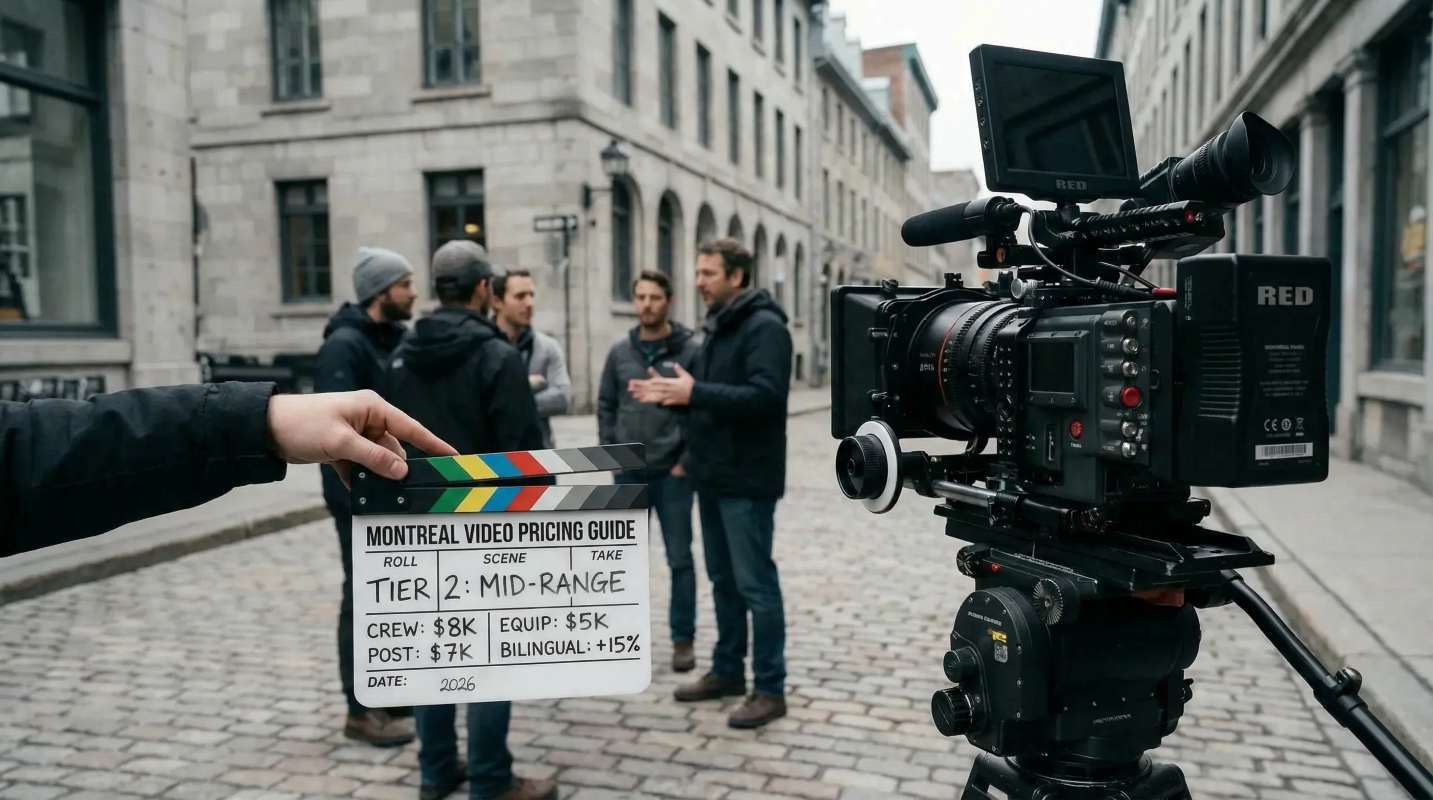
You're searching for video production pricing in Montreal, and most agencies give you the same response: "It depends."
That's technically accurate. But it's also useless.
What you actually need is a framework that shows you what drives costs, where Montreal sits compared to other production hubs, and what specific price ranges look like for different types of video work.
This isn't a sales pitch. It's a diagnostic breakdown of Montreal's video production market, built from verified pricing data and structural cost factors that most comparison guides ignore completely.
The Montreal Production Market: Context You Need First
Montreal controls approximately 25% of Canada's $12.2 billion film and television production volume. That positions it as one of three major production hubs alongside Toronto and Vancouver.
But here's what matters for your budget: Montreal operates with a structural cost advantage over Toronto while maintaining comparable production infrastructure.
Production expenses in Toronto run at least 50% higher than smaller markets because of elevated cost-of-living expenses. Montreal sits between Toronto's premium pricing and Vancouver's budget positioning, offering you access to sophisticated production capability without Toronto's cost premium.
That cost differential isn't trivial when you're budgeting annual video content.
Verified Price Ranges: What Montreal Companies Actually Charge
Montreal video production costs span three distinct tiers based on crew size, equipment complexity, and production duration.
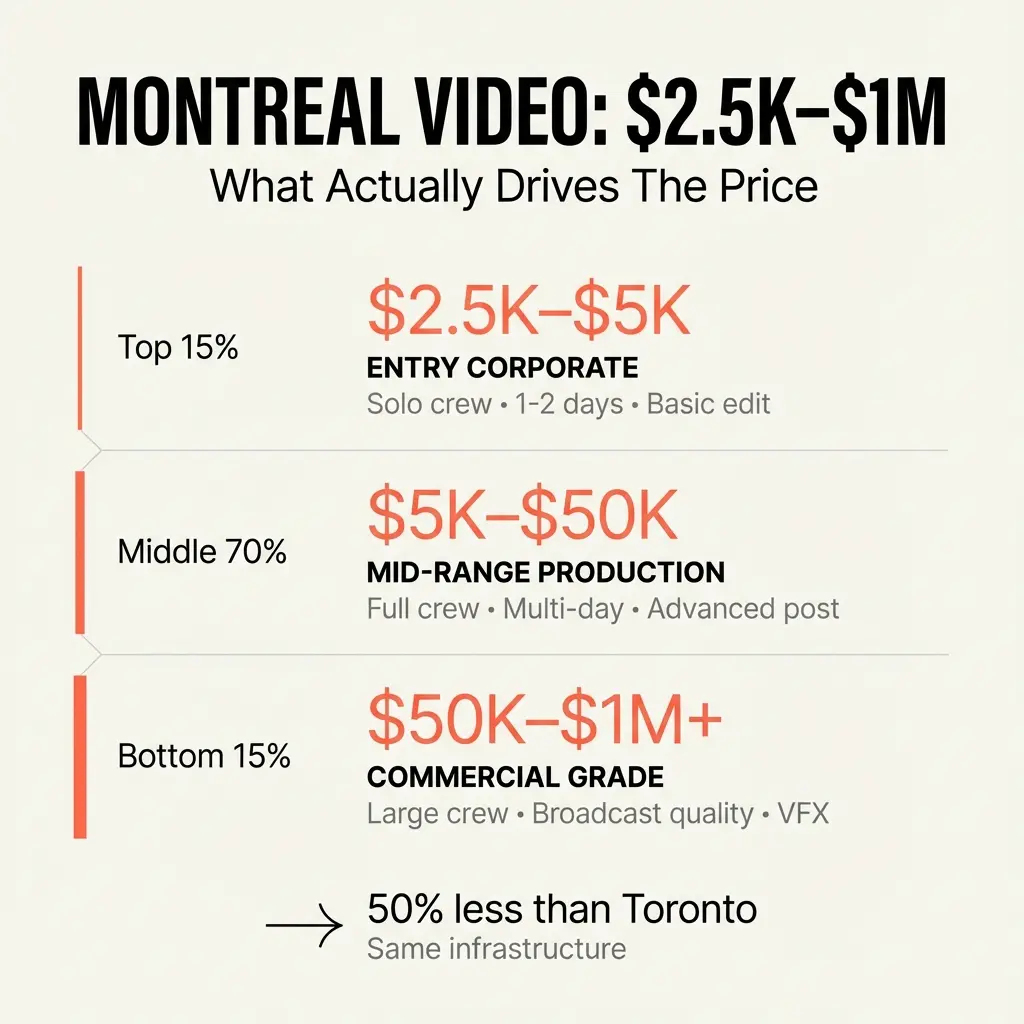
Entry-Level Corporate Video: $2,500–$5,000
This range gets you a solo videographer or small two-person crew handling straightforward corporate content.
What's included:
- Basic interview setups
- Single-location shoots
- Standard editing with basic graphics
- One to two days of total production time
- Deliverables optimized for web and social
What's not included: Complex scripting, multiple locations, professional actors, custom motion graphics, or extensive post-production revisions.
This tier works when you need functional video content without elaborate production requirements.
Mid-Range Production: $5,000–$50,000
This is where most corporate video work lives. You get larger crews, sophisticated lighting and camera setups, and professional-grade post-production.
What changes at this level:
- Multi-day shoots with location variety
- Dedicated crew roles (director, cinematographer, audio specialist)
- Professional scriptwriting and storyboarding
- Advanced color grading and motion graphics
- Multiple revision rounds built into the contract
The wide range reflects project complexity variation. A $8,000 project might involve a single-day shoot with a four-person crew, while a $35,000 project could span multiple locations over several days with extensive post-production work.

High-End Commercial Production: $50,000–$1,000,000+
This tier enters commercial advertising territory where production values match broadcast television standards.
You're paying for:
- Large production crews with specialized roles
- Professional talent and casting services
- High-end camera systems and lighting packages
- Multiple shooting days with complex logistics
- Extensive post-production including visual effects
- Music licensing or original composition
Most corporate clients never need this level. But if you're producing brand campaigns for mass distribution or content requiring cinematic production quality, this is where pricing starts.
The Bilingual Production Factor: Hidden Complexity That Impacts Cost
Here's what most pricing guides miss entirely: bilingual production capability isn't just translation.
Montreal produced 42 of Canada's 149 theatrical feature films in 2022/23, with the majority being French-language productions. That concentration creates specialized talent pools that don't exist in Toronto or Vancouver.
When you need truly bilingual content, you're not just paying for translation services. You're paying for:
- Scriptwriting that works idiomatically in both languages
- Talent comfortable performing in French and English
- Directors who understand cultural nuance beyond literal translation
- Editors who can maintain pacing across language versions
Script writing services cost between $800 and $2,500 per day for experienced writers. Bilingual requirements push costs toward the upper range because you're not just translating—you're adapting for cultural context and linguistic rhythm.
If your organization serves both English and French-speaking markets, Montreal's bilingual production infrastructure becomes a structural advantage. You get native-level execution in both languages without coordinating between separate production companies.
Cost Components Most Companies Don't Break Down
When you receive a quote, it typically shows a single total figure. But understanding the underlying cost structure helps you evaluate whether you're getting appropriate value.
Pre-Production and Project Management: $50–$150/hour
This covers concept development, scriptwriting, storyboarding, location scouting, and production coordination. The hourly rate varies based on project complexity and the seniority of the team handling pre-production.
Budget 15-25% of your total project cost for pre-production. Skimping here creates problems during production that cost significantly more to fix.
Production Day Rates
Studio rental: $500–$5,000 per day depending on facility sophistication and included equipment.
Crew rates: Vary by role and experience level. A small crew (3-4 people) might run $3,000–$6,000 per day, while larger commercial productions with specialized roles can exceed $15,000 daily.
Location management: Starts at $1,000–$2,500 for basic location securing and site management. This line item often gets overlooked until you're dealing with permits and location access issues.
Post-Production Variables
Stock footage licensing: $80–$300 per clip. If your video requires multiple stock shots, this adds up quickly.
Music: Stock music libraries offer tracks for $50–$200. Original composition runs $350–$2,000 per piece depending on complexity and usage rights.
Color grading and finishing: Professional color work adds $500–$2,500 depending on footage volume and desired aesthetic.
The choice between stock and original assets significantly impacts your budget without changing the final video's runtime.
The 2026 Production Landscape: What's Changing
The video production market is experiencing structural shifts that affect both pricing and what you should actually be buying.
Corporate video demand grows by 15% yearly, with spending projected to exceed $30 billion in 2026. That growth comes with a fundamental change in what constitutes valuable video content.
The traditional model optimized for polish and production value. The emerging model optimizes for relevance, speed, trust, and repeatability.
What that means practically: the job is no longer "make a great video." The job is "publish credible, modern content consistently without slowing your business down."
Short-form video content between 15-60 seconds dominates current demand, driven by TikTok, Instagram Reels, and YouTube Shorts. This format shift requires production models emphasizing fast turnaround and clean visuals over elaborate cinematography.
If you're still budgeting for one or two high-production-value pieces per year, you're operating with an outdated content model. The market has moved toward consistent output at moderate production quality over occasional output at maximum production quality.
Tax Incentives and Infrastructure Advantages You Can Actually Use
Canada's film production maintains cost advantages through favorable exchange rates and tax incentives. The Canadian Film or Video Production Tax Credit provides a 25% tax refund on qualified worker salaries for eligible productions.
Here's what matters: most Canadian incentives are available to projects with budgets of at least $1 million. But smaller-budget projects also have access to incentive funds, creating opportunities for corporate work that wouldn't qualify in other jurisdictions.
Quebec maintains established animation and visual effects bonuses beyond the basic tax credit rate. This has driven multiple digital service providers to establish operations in Montreal, creating a concentration of post-production capability that affects pricing and turnaround times.
You're not directly accessing these tax credits as a client. But they shape the production ecosystem you're buying from, affecting both cost structure and available capabilities.
What Pricing Transparency Actually Reveals
Most Montreal video production companies avoid publishing specific pricing. That's not necessarily because they're hiding information. It's because project variables genuinely create wide cost ranges.
But here's what the lack of pricing transparency often masks: agencies that can't articulate clear pricing structures usually lack systematic production processes.
When you encounter a company that provides detailed pricing breakdowns, you're seeing evidence of operational maturity. They've produced enough similar projects to understand cost drivers and can communicate them clearly.
Conversely, vague pricing often indicates one of two conditions:
- The agency hasn't systematized their production process enough to predict costs accurately
- They're using pricing opacity to maximize per-project margins through information asymmetry
Neither condition serves your interests.
The Selection Framework You Actually Need
Pricing matters. But it's not the primary selection criterion.
What you're actually evaluating:
Portfolio diversity: Do their previous projects demonstrate capability with content similar to what you need? Generic portfolio breadth matters less than specific relevant experience.
Production process clarity: Can they articulate their workflow from concept through delivery? Vague process descriptions predict vague project management.
Bilingual capability depth: If you need French and English content, verify this goes beyond translation services. Review their French-language work specifically.
Revision policy specificity: How many revision rounds are included? What constitutes a revision versus a scope change? Ambiguity here creates budget conflicts later.
Timeline realism: Aggressive timelines often indicate inadequate pre-production or post-production corners that will be cut.
The lowest quote frequently becomes the most expensive option once you account for revision costs, timeline delays, and rework.
What This Data Actually Tells You
Montreal video production pricing reflects a mature market with established infrastructure and competitive dynamics.
You're not going to find dramatically cheaper production here than in other major Canadian markets. But you will find cost advantages over Toronto while maintaining access to comparable production capabilities and specialized bilingual talent.
The pricing ranges provided here give you calibration points for evaluating quotes. If you receive a proposal significantly below these ranges, investigate why. Legitimate cost reductions come from production efficiency, not from cutting corners on crew quality or post-production time.
If you receive quotes significantly above these ranges, ask for detailed breakdowns showing where the additional cost delivers additional value.
The goal isn't finding the cheapest option. The goal is understanding cost structure well enough to identify where you're paying for value versus where you're paying for inefficiency or information asymmetry.
That's the diagnostic framework you need before you sign a production contract.